Tuesday, October 30, 2007

More on Instone-Brewer's Article in Christianity Today

David Instone-Brewer's article "What God Has Joined" Christianity Today's article has generated a lot of discussion. The CT editor, Jeff Neff and I-B himself responded. In the meanwhile David Instone-Brewer has started a blog. And the blogoshere itself is abuzz with the debate between I-B and John Piper. Piper is of the 'divorce (really separation) but no remarriage' school of thought. As I said before I think that Piper's thinking is flawed and thus ends up being overly harsh. As I-B notes in his C-T response:

  • John Piper’s own interpretation of the divorce passages is based on the view that porneia (Greek for ‘sexual indecency’) had a different meaning in first century Judaism, when it referred mainly to ‘fornication’ (i.e. sexual sin before marriage). This well-established theory was popularized a few decades ago by the Catholic scholar Murphy O’Connor, who found supporting evidence in the Dead Sea Scrolls. This interpretation is important for Catholic scholars because it means that Jesus did not allow any divorce after marriage has occurred – the same teaching that Piper supports.

This evidence from the Dead Sea Scrolls was based on only one passage, a particularly difficult one, in the Damascus Document, which relies on the translation of the word zenut (the Hebrew equivalent of porneia) as "sex before marriage". Since O’Connor put forward this theory, however, other scrolls have been studied (especially the Temple Scroll) and most scholars have concluded that the early interpretations of this passage were mistaken, and that it was actually forbidding polygamy.

This does not mean that John Piper’s non-traditional interpretation of porneia is wrong (it is still a possible interpretation that is waiting for more evidence), but it does mean that we do not now have much evidence that it can be translated this way. In fact, most scholars agree that porneia is a general term for sexual sin, as seen in the New Testament itself. It is used for visiting a prostitute (1 Cor.6.13-15, 18), incest (1 Cor.5.1), general sexual sin by a married person (1 Cor.7.2), use of cultic prostitutes (Rev.2.20-21) and the sin of the ‘whore of Babylon’ (Rev.17.2, 4; 18.3; 19.2) - though the most common meaning is ‘sexual sin in general’ (e.g. Acts 15.20; Eph.5.3; Col.3.5).

The main thrust of I-B argument is that Jesus was questioned on the meaning of ‘indecency’ in Dt. 24:1 and no more in Matthew 19:3 (Link 1, 2, 3).

Matthew 19:3. (NASB) Some Pharisees came to Jesus, testing Him and asking, "Is it lawful for a man to divorce his wife for any reason at all?”

Note that the Pharisees were testing Him on for his opinion on the law. To the 1st century Jew that was the OT Law of Moses. The Pharisees were divided into two camps, based on Rabbis Shammai and Hillel. This debate is recorded in the Talmud:

Babylonian Talmud: Tractate Gittin 9:10 on the controversy regarding the interpretation of Dt 24:1.

  • The School of Shammai said: Let not a man divorce his wife unless he found in her some matter of indecency [immorality] as it is said, “because he has found an indecency about her” [Dt 24:1]. But the School of Hillel say: Even if she spoiled his food, as it says, “because he has found an indecency of something about her” [Dt 24:1].
  • It has been taught: Beth Hillel said to Beth Shammai: Does not the text distinctly say 'thing'?7 Beth Shammai rejoined: And does it not distinctly say 'unseemliness'? Beth Hillel replied: Had it said only 'unseemliness' without 'thing', I should have concluded that she should be sent away on account of unseemliness, but not of any 'thing'.

The debate was clearly about the interpretation of indecency in Dt. 24:1. The Hillel Pharisees were the proponents of the “Any Cause/Reason/Matter/Thing” divorce. In the 1st Century AD the Hillel Pharisees were clearly winning that debate as evident from passages in Philo and Josephus on Dt. 24:1.

Philo (20 BC – 50AD) Special Laws 30-31(on Dt 24:1-4):

  • If a woman after parting from her husband for any cause whatsoever marries another and then again becomes a widow, whether this second husband is alive or dead, she must not return to her first husband but ally herself with any other man rather than him, because she has broken with the rules that bound her in the past and cast them into oblivion when she chose new love-ties in preference to the old.

Josephus (37AD – 100) Jewish Antiquities 4:253 (on Dt 24:1-4) :

  • He that desires to be divorced from his wife for any cause (25) whatsoever, (and many such causes happen among men,) let him in writing give assurance that he will never use her as his wife any more; for by this means she may be at liberty to marry another husband,

· footnote (25) from above: These words of Josephus are very like those of the Pharisees to our Savior upon this very subject, Matthew 19:3

Key Point - Note that Philo and Josephus use the term “Any Cause” as opposed to indecency in their interpretation of Dt. 24:1. This is a clear indication that the Hillel “Any Cause” divorce was the accepted one in 1st Century Judaism, not the Shammai definition meaning only adultery.

In spite of many blog sites denying so, the ‘Any Cause’ divorce is a 1st century AD Jewish legal term equivalent to our modern No-Fault divorce. Modern Jewish attitudes on divorce still accept this notion.

In upcoming posts, I’ll explore Instone-Brewer’s thoughts on other grounds for divorce, namely:

  • Adultery (in Deuteronomy 24:1, affirmed by Jesus in Matthew 19)
  • Emotional and physical neglect (in Exodus 21:10-11, affirmed by Paul in 1 Corinthians 7)
  • Abandonment and abuse (included in neglect, as affirmed in 1 Corinthians 7)

Friday, October 26, 2007

Instone-Brewer in Christianity Today

Instone-Brewer in Christianity Today

David Instone-Brewer has an article in Christianity Today on divorce and remarriage in the Bible. He cites the Hillel vs. Shammai Pharisaical debate over the meaning of “indecency” in Dt. 24:1 and the correspondence of Paul’s 1 Co 7 with Ex. 21:10-11. Instone-Brewer’s thesis is that the discussion outlined in the most detail in Matthew 19 (as opposed to Luke's, and Mark's) is that was a debate on 'indecency' in Dt 24:1 and not about Ex 21:10-11. Historical references, admittedly, extra-biblical back up Instone-Brewer. So a reasonable interpretation is that the liberal “Any Cause” Hillel divorce (1, 2, 3, 4, 5) was condemned by Jesus and the discussion in Mt 19 was not about Ex 21:10-11. The Talmud, Josephus, and Philo all mention this “Any Cause” divorce (also 1). The Talmud records this debate with Josephus and Philo inserting ‘Any Cause’ in place of ‘indecency’ for their interpretation of Dt 24:1. Modern Jewish opinions towards divorce remain the same, i.e. ‘Any Cause’ (equivalent to the modern No-Fault) for Dt. 24:1 and Ex. 21:10-11 being in place also.

So the question remains what was Jesus’ opinion on Ex. 21:10-11? I side with Instone-Brewer as from all reliable historical references; the Pharisees were questioning Him on Mosaic Law and His opinion of ‘indecency’ in Dt.24:1. The rights of slave-wife of Ex 21:10-11 were always accepted as grounds for divorce then as it is now. John Piper whose teachings I respect disagrees, and offers this criticism. The crux of his argument is with I-B’s interpretation of Ex. 21:10-11 in italics:

1) His claim that Jesus didn’t reject the (ostensible) grounds for divorce in Exodus 21:10-11 is an argument from silence. Jesus never alluded to these verses. And when he did speak about Old Testament grounds for divorce, he rejected them as owing to the hardness of heart (Matthew 19:8; Mark 10:5).

I-B does mention this in his writings. Silence can be a vague method of stating an argument. We know that the 1st century Jews as with the modern ones have accepted grounds for divorce. We know from historical references the debate was over ‘indecency’ in Dt 24:1. Piper also seems to miss the point of Mt 19:8. In the preceding verse the Pharisees asked Jesus as to why “Moses commanded one to give a Certificate of Divorce and to send her away?” There is only one situation where that appears in the Law of Moses, Dt 24:1. That was when the husband found an ‘indecency’ in her.

2) Keil and Deilitzsch have a totally different take on these verses than Instone-Brewer which does not assume that the purchased slave was already married to the purchaser when she is dismissed (Commentaries, Vol. 2, p. 131).

I haven’t read this criticism before. But if read at face value, Ex 21:10-11 seems very straight forward. Enough so that Paul basically re-iterates these values in 1 Co 7.

3) Worst of all, Instone-Brewer infers three grounds for divorce from Exodus 21:10-11, neglect of “food, clothing, and love.” These correspond to “later Jewish and Christian” marriage vows: “love, honor, and keep.” He then concludes—read and weep—“Thus, the vows we make when we marry correspond directly to the biblical grounds for divorce [namely, ‘emotional and physical neglect’].”

This is a valid argument, perhaps Ex. 21 can be abused, I’m sure it is in modern Jewish practices. However, what about cases in which spouses are abandoned? That’s pretty clear cut, yet Piper does not consider this to be valid grounds for divorce. He is of the 'divorce but no remarriage' school of thought.

Piper goes on:

Instone-Brewer’s interpretation is an example (common, it seems, in New Testament studies today) of taking extra-biblical observations and using them to silence the fairly plain meaning of biblical texts. Over against what Instone-Brewer says, Jesus did in fact reject, for his disciples, what Moses commanded (Mark 10:5) or permitted (Matthew 19:8) in Deuteronomy 24:1.

In considering extra-biblical sources one must consider what was Jesus teaching for all in all ages to come or against 1st century AD customs and practices. This is always a fine line. It’s apparent to me that the Mt 19 debate was solely about Dt. 24:1 and not about Ex 21:10-11. Matthew 19:8 was about forgiveness for the offending wife, even when Moses commanded that a Certificate of Divorce was required for the offence in Dt. 24:1.

Piper again:

My aim here is not to persuade people that this understanding of the exception clause is right. My aim is to say that David Instone-Brewer’s argument is not compelling—neither the argument from the “any-cause divorce” in rabbinic literature, nor the argument from Exodus 21:10-11. It is what I caution my students against. Beware of what looks like scholarly rank-pulling. For example, Brewer says, “I likely read every surviving writing of the rabbis of Jesus’ time.

If we do not understand the mindset of the 1st century Jew we won’t understand the message of Jesus. The NT was written for that audience, e.g. consider the situation of the tax collector. Ironically, Jesus and Paul’s messages were against easy divorce and is very applicable to the modern day situation of No-Fault divorces. Also, ad hominen attacks do add to the validity of one’s argument.

In that C-T article I-B takes a round of criticism from readers. He mounts a defense of himself in one of his sermons. Most of the reader comments attack Ex 21:10-11 as any source of teaching. This is unfortunate as rabbinical sources have always used Ex 21. What do Christians find objectionable to Ex. 21:10-11? This reinforces the notion that we as Christians should always keeping learning (Hebrews 5:13-14).

Monday, October 22, 2007

Iraqi Deaths from the UN Sanctions and from the US-led Invasion/Occupation

There is a common belief promulgated by the anti-war left and the MSM that US-led invasion is causing widespread misery and death in Iraq. Over at the anti-war website Iraq Body Count, there is the figure of 75,458-82,203 as of October 22, 2007. That's a large figure but remember that most of these deaths were from sectarian violence.

What were the deaths prior to the US-led invasion? In 1990 the UN sanctions barred the importation of simple chemicals such as chlorine for disinfection. Chlorine can be used in chemical weapons. The result can be summarized in this Wikipedia Article:

  • The sanctions regime was finally ended on May 22, 2003 (with certain arms-related exceptions) by paragraph 10 of UNSC, after approximately 1.5 million people had died.Resolution 1483. [18]

May 22, 2003 marked the beginning of the US-led invasion of Iraq. 80,000 vs. 1.5 million

Friday, October 19, 2007

Thursday, October 18, 2007

Half of New Jersey Wants Out

I lived in one of those red counties in NJ from 1989-93. The type of place where most of the tax revenue for the NJ state government would flow from. Foxnews has a story unlikely to be picked up by other news media. This is a story about those poor devils:

Poll Finds Almost Half of New Jersey Adults Want to Move Out of State

Thursday , October 18, 2007 By Sara Bonisteel

FC1


Even New Jerseyans can't stand living in New Jersey, according to a new poll that said nearly half of adults residing in the Garden State want to pull up stakes.

.....

Poll participants cited high property taxes (28 percent), the cost of living (19 percent), state taxes (5 percent) and housing costs (6 percent) as the main reasons they want out. The poll also found that 51 percent of those who expressed a desire to leave planned to do so, with adults under the age of 50 making between $50,000 and $100,000 the most likely to flee....[more]

Tuesday, October 16, 2007

Modern Jewish Attitudes Towards Divorce

Jewish views of divorce have remained constant over 2500 years. The website below goes as a far as to equate the ancient “Any Cause” (link 1, 2, 3, 4)) with the modern “No-Fault” divorce.

From Judaism 101:

  • Judaism recognized the concept of "no-fault" divorce thousands of years ago.
  • Under Jewish law, a man can divorce a woman for any reason or no reason. The Talmud specifically says that a man can divorce a woman because she spoiled his dinner or simply because he finds another woman more attractive, and the woman's consent to the divorce is not required.

This is a reference to the “Any Cause” divorce to which the Pharisees questioned Jesus in Matthew 19:3. The interpretation of the Hillel Pharisee was that any infraction is grounds for divorce. The Shammai Pharisee held to the stricter formulation of “sexual immorality” grounds only. This debate was one recorded in the Talmud over the meaning of “indecency” in Dt. 24:1.. Jesus preaches against the “Any Cause” divorce in verse 19 by affirming the Shammai position for sexual immorality only position. The Hillel Pharisees prevailed in post 70AD Judaism after the destruction of the 2nd Temple, thus the modern position that reflects the “Any Cause” divorce.

  • In fact, Jewish law requires divorce in some circumstances: when the wife commits a sexual transgression, a man must divorce her, even if he is inclined to forgive her.

In the bullet point above, Jesus rejects required divorce by reminding the Pharisees that forgiveness was and is always an option in verse 8 of Mt 19.

  • According to the Torah, divorce is accomplished simply by writing a bill of divorce, handing it to the wife, and sending her away. To prevent husbands from divorcing their wives recklessly or without proper consideration, the rabbis created complex rules regarding the process of writing the document, delivery, and acceptance. A competent rabbinical authority should be consulted for any divorce.

That bullet point above is in direct reference to Certificate of Divorce in Dt. 24:1.

The next passage taken from Judaism 101 is in reference to Ex. 21:10-11. In this situation a slave wife is set free in the case of neglect/abandonment.

  • a rabbinical court can compel a husband to divorce his wife under certain circumstances: …., when he violates or neglects his marital obligations (food, clothing and sexual intercourse)

Instone-Brewer makes reference to this verse, and further expounds that in 1st century AD many Jews reasoned what is good for the slave wife, is good for the free one, and thus good for the husband. This point was never in debate between the Hillels and Shammais over Dt. 24:1. It is highly unlikely that Jesus was commenting on Ex 21. Further evidence is offered in 1 Corinthians 7, St. Paul makes references to the causes of martial discourse and alludes to Ex 21 in verses 3-5 and 33-34. In verses 10-11 and 15-16 he addresses the issues of abandonment. To the Greco-Roman Corinthians this was a type of "No-Fault" divorce.

Sunday, October 14, 2007

Saturday, October 13, 2007

Ross Jardine = Wade Cook

This guy has been on the radio hawking financial bunk. Sounds very much like this guy who took down a family I once knew very well. Justice delayed.

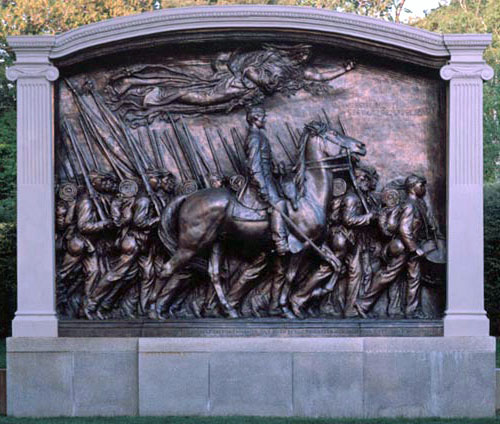
54th Massachusetts


54th Massachusetts, real Civil War heroes.

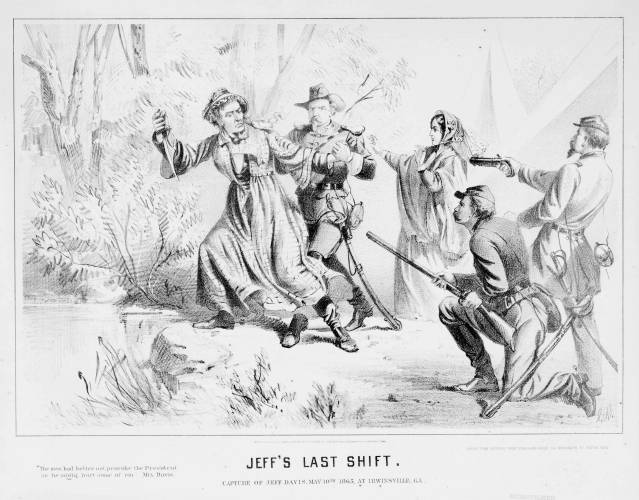
Jefferson Davis' Dress


I wonder if he wore makeup and what was his dress size? A heroic last stand.

From the November 22, 1873 NY Times:

"JEFF. DAVIS' DISGUISE.; HIS ATTEMPT TO ESCAPE CAPTURE IN A WOMAN'S DRESS STATEMENT OF GEN. PRITCHARD"

Capture of Jefferson Davis, at Irwinsville, GA., wood engraving, Frank Leslie's Illustrated Newspaper, June 1865.

Lot's more great images at GMU's web site.

Tuesday, October 02, 2007

John Polkinghorne

Rev. Dr. John Polkinghorne, KBE, FRS, PhD, ScD, MA, (born October 16, 1930 in Weston-super-Mare, England) is a British particle physicist and theologian. He has written extensively on matters concerning science and faith, and was awarded the Templeton Prize in 2002...[more from Wikipedia]

A website where he answers questions about Science and God.

Stallone on Myanmar

Oct 1, 4:21 PM (ET)

By JEFF WILSON

LOS ANGELES (AP) - Sylvester Stallone says he and his "Rambo" sequel movie crew recently witnessed the human toll of unspeakable atrocities while filming along the Myanmar border.

"I witnessed the aftermath - survivors with legs cut off and all kinds of land-mine injuries, maggot-infested wounds and ears cut off," Stallone told The Associated Press in a phone interview Monday. "We hear about Vietnam and Cambodia and this was more horrific."...[more]

Sunday, September 30, 2007

Civics Quiz

Some bragging here:

See the USA Today news story on this quiz.

So 85% may not be all that good given the pool of test takers. Oh well.

***********************

The civics literacy test covered American history, government and political thought, plus international affairs and the market economy. Some highlights:
Group Freshman average Senior averge
Havard (top seniors) 63.59% 69.56%
Yale (top freshmen) 68.94% 65.85%
St. Thomas Univ. (Fla.) - 1 (lowest freshmen and seniors) 29.75% 32.50%
Eastern Conn. State - 1 (biggest gain) 31.34% 40.99%
Cornell (biggest loss) 61.90% 56.95%
Combined scores/State non-flagship universities 41.50% 47.40%
Private, secular non-Ivy universities 56.20% 60.10%
State flagship universities 50.70% 54.40%
Catholic universities 45.20% 48.30%
Protestant universities 53.80% 56.60%
Ivy League universities 64.00% 64.10%

Friday, September 28, 2007

As Prices Soar, U.S. Food Aid Buys Less

From the NY Times. Something to think about in this upcoming push for "biofuels." Have you seen the price of milk in the US lately?


By CELIA W. DUGGER Published: September 29, 2007

Soaring food prices, driven in part by demand for ethanol made from corn, have helped slash the amount of
food aid the government buys to its lowest level in a decade, possibly resulting in more hungry people around the world this year.

The United States, the world’s dominant donor, has purchased less than half the amount of food aid this year that it did in 2000, according to new data from the Department of Agriculture....[
more]

Thursday, September 27, 2007

Sabians followers of John the Baptist

Are these the followers of Apollos mentioned in Acts as the preacher of the baptism of John? The Wikipedia article on them only traces them back to 900 AD. Apollos later became a Christian through Aquila and Priscilla.

By Zaid Sabah, USA TODAY

BAGHDAD — Dressed in gleaming white robes, a small group of Sabians gathered on a Sunday afternoon to wash away their sins — and to forget about the problems facing Iraq and the followers of their ancient religion.

The Sabians belong to a centuries-old sect that follows the teachings of John the Baptist but is neither Muslim nor Christian. Flowing water plays a symbolic role in their faith, and several people were baptized at the recent ceremony, including three couples who were getting married....[More]

Wednesday, September 26, 2007

Was the 'Big Bang' Creation?

As a scientist spending most of my life as an agnostic, and cultural Catholic, it always seemed to me that the Big Bang was the beginning of creation. It certainly fits Genesis 1's description. Einstein appeared to pull back from the idea of the Big Bang as it would imply a creator. he preferred to think of constant universe rather than one with a beginning:

  • Albert Einstein's reaction to the consequences of his own general theory of relativity appear to acknowledge the threat of an encounter with God. Through the equations of general relativity, we can trace the origin of the universe backward in time to some sort of a beginning. However, before publishing his cosmological inferences, Einstein introduced a cosmological constant, a "fudge factor," to yield a static model for the universe. Einstein later considered this to be the greatest blunder of his scientific career.
  • Einstein ultimately gave grudging acceptance to what he called "the necessity for a beginning" and eventually to "the presence of a superior reasoning power." But he never did accept the reality of a personal God.

Einstein didn't believe quantum theory either as it would imply God played dice.

I couldn't get to sleep last night and listened to radio, a physicist, Lawrence Krauss was on declaring that the Big Bang was evidence that biblical creation do not happen. Radio host didn't press with more questions, but this is one Christian who wholeheartedly disagrees.

Krauss went on to say intelligent design was bunk and the theory of evolution is the basis of modern drug design. I don't believe as a physicist, Krauss has designed any successful drugs. I know of at least one who has. Phil Skell, a former professor of mine at Penn State and a member of the National Academy of Sciences has this to say:

  • Evolution Theory is a broadly overarching historical theory that pertains to the developmental history of living organisms over the past 3.5 billion years. It is reasonable to examine its credentials and determine its current utility. Does it have a directive impact in the inductive, or experimental, sciences, such as Physics, Chemistry, and Biology? Despite statements in the literature that make it out to be vitally important in modern Microbiology, Neurobiology, Genetics, Plant Biology, Medicine, Surgery, Pharmaceutics, etc., I believe this assignment to evolutionary theory cannot be justified. Nobel Laureate, Francis Crick wrote: "It might be thought that evolutionary arguments would play a large part in guiding biological research, but this is far from the case." I am mindful of the statement of a professor at a prestigious medical school, that Darwin is not mentioned in the four-year medical program. And, another from a researcher in the pharmaceutical industry, that his company does not have a Division of Darwinian Concepts to help in making more effective their choices for future research.
  • Over A half century ago, during WW II, I was personally associated with an antibiotics research group, engaged in the full range of activities, from finding organisms which inhibited bacterial growth to the isolation and proof of structure of the antibiotics they produced. Since then there has been astounding sophisticated advances in instrumentations and methodologies, but nonetheless persons engaged in current activities make no more use of Darwinian Concepts than in those earlier days; those Concepts do not, and did not, have a determinative impact on the conception and prosecution of the projects.

Militant Darwinists seem to promulgate the idea that all of modern science rests upon the theory of evolution. Everything from microchips to drug design will suffer if evolution isn't taught in grade school without any doubts. Evolution should be taught, but there are holes big enough to fit a truck through with clearance.

I have a good friend, and colleague who invented the glucose detector while we were both graduate students at Penn State. The device is the one you can buy anywhere, and has probably saved 10,000's of lives. He was then and is now a 6-day creationist. I believe in old earth so we differ there. But he and I would agree that the everyday successful functioning of science does not depend on accepting evolution without doubts.

Monday, September 24, 2007

Matthew 5:17-20, 12:1-14, 30-32

My reading at Church Yesterday

Jesus speaks on the Law of Moses in the Sermon on the Mount:

Matthew 5:17-20

  • 17 "Do not think that I came to abolish the Law or the Prophets; I did not come to abolish but to fulfill. 18 "For truly I say to you, until heaven and earth pass away, not the smallest letter or stroke shall pass from the Law until all is accomplished. 19 "Whoever then annuls one of the least of these commandments, and teaches others to do the same, shall be called least in the kingdom of heaven; but whoever keeps and teaches them, he shall be called great in the kingdom of heaven. 20 "For I say to you that unless your righteousness surpasses that of the scribes and Pharisees, you will not enter the kingdom of heaven.
Christians are not under the Law but rather righteousness. But see how Jesus applies the righteousness that God intended in the Law given to the Jews in the following:

12:1-50

  • 1 At that time Jesus went through the grainfields on the Sabbath, and His disciples became hungry and began to pick the heads of grain and eat. 2 But when the Pharisees saw this, they said to Him, "Look, Your disciples do what is not lawful to do on a Sabbath." 3 But He said to them, "Have you not read what David did when he became hungry, he and his companions, 4 how he entered the house of God, and they ate the consecrated bread, which was not lawful for him to eat nor for those with him, but for the priests alone? 5 "Or have you not read in the Law, that on the Sabbath the priests in the temple break the Sabbath and are innocent? 6 "But I say to you that something greater than the temple is here. 7 "But if you had known what this means, (quotes Hosea OT) `I DESIRE COMPASSION, AND NOT A SACRIFICE,' you would not have condemned the innocent. 8 "For the Son of Man is Lord of the Sabbath." 9 Departing from there, He went into their synagogue. 10 And a man was there whose hand was withered. And they questioned Jesus, asking, "Is it lawful to heal on the Sabbath?"--so that they might accuse Him. 11 And He said to them, "What man is there among you who has a sheep, and if it falls into a pit on the Sabbath, will he not take hold of it and lift it out? 12 "How much more valuable then is a man than a sheep! So then, it is lawful to do good on the Sabbath." 13 Then He said to the man, "Stretch out your hand!" He stretched it out, and it was restored to normal, like the other. 14 But the Pharisees went out and conspired against Him, as to how they might destroy Him.

The Pharisees go on to test Jesus again and accuse him of sorcery later, He has this to say:

The Christian is under the Holy Spirit. How then should a Christian who is under the guidance of the Holy Spirit view the Law of Moses? Christ came to fulfill the Law. With the Law there is righteousness that should be apparent to the Christian. In the 613 Commandments for example there is
  • 31. Not to take revenge (Lev. 19:18)
It is good that we not take revenge, but what did Jesus teach us in his Sermon on the Mount? In Mt 5:21-22 it is that just anger is evidence of guilt. It is indeed there in Lev. 19:18. However does Lev 19: 19 & 20 impact a Christian? These are things in which the Holy Spirit guides us. In those Laws there is righteousness intended by the Lord for all ages.

Sunday, September 23, 2007

The Tax Collector in The Gospels The 1st and 21st Century Contexts

The tax collector earned the scorn of the gentile, common Jew, the Pharisee, and Jesus in the Gospels. Jesus recognizes that the tax collector was a man in need of redemption in Matthew and Luke (another Link). His apostle, Matthew was a tax collector before he sought salvation.

How do we perceive the tax collector in the 21st century? I'm sure there are many Christians working for our IRS. How do they justify the righteousness of working as tax collectors when they are so scorned as sinners in the Gospels? If read without context, the tax collector in modern America is a sinner and should give back half of anything he earned to the poor, and perhaps make severe restitution to others.

Christians working for the IRS should rest easy. The Gospels were written in the 1st Century AD with the Jews and others under the domination of Romans. The Jews suffered under this occupation and tax collectors were part of the Roman apparatus for domination of Judea. In modern America, we have control of the tax collector (in principle) and they are in the service of a government we have elected.

This underscores the importance of reading Scriptures in its historical context. The word of God is made clearer to us when we consider the historical context in which human hands wrote scripture.

*******
Note added Sept. 28 - Wikipedia article on publicans

Thursday, September 13, 2007

Notre Dame and Michigan

As we go in this weekend's battle of the 0-2 giants consider:
  • Such underperformance raises a serious question about whether Notre Dame, and similarly Michigan, can hope to contend regularly for national championships without lowering their rigorous academic standards. ....[more from NY Times]

  • In assessing Penn State’s 31-10 victory over Notre Dame, Joe Paterno said at his weekly news conference: “Notre Dame has got some problems. They didn’t challenge us, really.”
Take advice from Joe Pa, he knows all about lowering standards.

Sunday, September 09, 2007

613 Commandments of Judaism

From Judaism 101:

  • Below is a list of the 613 mitzvot (commandments). It is based primarily on the list compiled by Rambam in the Mishneh Torah, but I have consulted other sources as well. As I said in the page on halakhah, Rambam's list is probably the most widely accepted list, but it is not the only one. The order is my own....[more]